Contact Vault Logo Contact Vault ALPHA v.1.3

Welcome to Contact Vault

"A secure email provider for anonymous job applications."

Why applicants use Contact Vault

Contact Vault gives applicants a private first-contact layer with employers before they expose a personal inbox.

Most applicants have to expose a personal email address before they know whether an employer is serious, responsive, or even safe to engage with. Contact Vault changes that first step.

You send a privacy-protected first-contact application through Contact Vault, the employer replies from their normal mail client, and you decide later whether to reveal more. It is not a recruiting marketplace and not another profile farm. It is a private first-contact layer for job applications.

Masked applicant at a desk using Contact Vault for first contact

Anonymous job applications vs anonymous email for job applications

Anonymous job applications usually refer to applying for roles while reducing identity signals before an employer decides whether to respond.

Contact Vault focuses on one practical part of that process: protecting your personal email address and ordinary inbox during first contact. If you want the broader explanation, read our guide to anonymous job applications.

How anonymous applications work

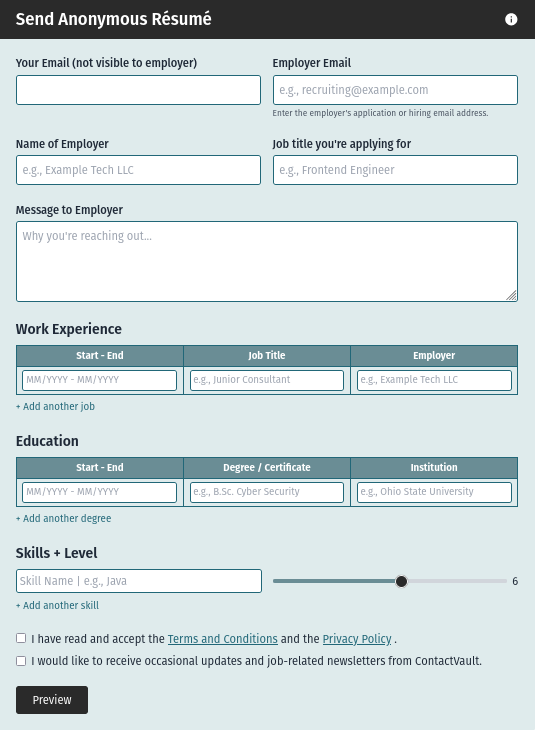
Write a focused first-contact application.

Add your message, relevant experience, education, and skill levels without uploading your personal résumé file.

Send it without exposing your personal email.

The employer receives a clean, structured email with response options that work inside their normal mail app.

Manage replies in your inbox.

You keep the thread history, drafts, sent applications, and follow-up decisions in one place.

What you keep under control

Your identity

Employers do not start with your private email address. First contact happens through Contact Vault until you decide otherwise.

Your timing

You can send now, save drafts for later, and keep all replies in one applicant inbox instead of scattering them across personal mail accounts.

Your exposure

First contact can stay minimal and deliberate, which matters if you are employed, vulnerable to bias, or simply cautious.

Mask symbolizing anonymous first contact

Whom is this for?

  • Applicants who do not want to expose a personal inbox too early.
  • People currently employed who need discretion during a job search.
  • Applicants concerned about bias tied to name, age, location, or background at first contact.
  • Anyone who wants a cleaner, more deliberate first-contact process than sending a raw résumé into the void.

Why first-contact control matters

Research and public guidance consistently point to the value of limiting unnecessary exposure during uncertain first contact:

  • Privacy control: 73% of U.S. adults surveyed by Pew Research Center said they had little or no control over what companies do with their data.
  • Recruitment data: the European Data Protection Supervisor notes that recruitment can involve extensive personal information and advises collecting no more than necessary.
  • Job-search risk: the U.S. Federal Trade Commission reported that losses to job scams topped $220 million in the first half of 2024.

These sources describe broader privacy and job-search conditions; they do not evaluate or endorse Contact Vault. Read the evidence and practical guidance.

Private mailbox for employer replies

Employers do not need to learn a new platform. They receive a structured application email, can respond from their existing mail client, and the conversation is routed back into your Contact Vault inbox. That means the employer side stays familiar, while you still keep first contact, reply handling, and follow-up communication separated from your ordinary private email.

  • No account creation required on the employer side.
  • No applicant identity leak by default during first contact.
  • Clear response paths for interest, rejection, portal redirects, or filled-role replies.
Screenshot illustrating the private mailbox for employer replies